How Mortgage Servicers Collect Interest Before Your Payment Reaches Principal
When you make a monthly mortgage payment, you might assume every dollar goes toward reducing what you owe. In reality, the system is designed so that interest gets collected first, often weeks before any principal is touched. Mortgage servicers—the companies that manage billing, collections, and escrow—operate a finely tuned machine that prioritizes their own cash flow over your equity buildup. Understanding how this machine works can save you thousands over the life of a loan.
The Daily Interest Machine: How Servicers Profit Before You Touch Principal
Most mortgages calculate interest on a daily basis, using the outstanding principal balance and a per-diem rate derived from the annual interest rate divided by 365 (or 360, depending on the loan). For a $300,000 loan at 6% annual interest, the daily interest is roughly $49.32. That means every day the loan is outstanding, the borrower accrues $49.32 in interest.
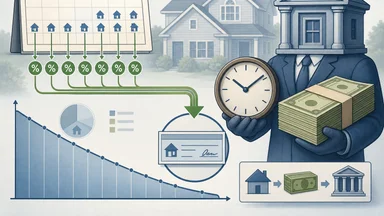
When you make a payment, the servicer first applies the funds to the accrued interest since the last payment date. Only after that interest is satisfied does the remainder reduce the principal. For a typical payment of $1,799 (on a 30-year fixed-rate loan), about $1,500 goes to interest in the early years, leaving just $299 for principal. The servicer then resets the interest clock, starting the daily accrual on the slightly reduced balance.
The key insight is that interest accrues every day, but payments are usually due monthly. The servicer collects interest for the full month, even if you pay early. If you pay on the 1st, the servicer holds your payment and applies it to interest that accrued over the previous 30 days. You are effectively paying interest on money the servicer already collected in prior months.
This daily interest mechanism means that the timing of your payment matters. Paying a few days late might not trigger a late fee within the grace period, but it does extend the number of days interest accrues on the unpaid balance, increasing the interest portion of your next payment. Servicers benefit from any delay, as they earn more interest income without changing the principal.
Some borrowers mistakenly believe that paying early reduces the interest charged. While it does reduce the principal balance for future accruals, the current month's interest is essentially locked in once the payment is due. Only by making extra principal payments can you meaningfully reduce the daily interest drag.
Consider a borrower who receives a bonus and decides to make an extra $5,000 payment in month 12. If applied to principal, this reduces the balance immediately, saving roughly $300 in interest over the next year (at 6%). But if the servicer misapplies it to future payments or fees, the borrower loses that benefit. This is why understanding the mechanics is crucial.
Why Your Monthly Payment Is a Two-Week Loan to the Servicer
Mortgage payments are often not applied to the loan on the day they are received. Instead, servicers place funds in a suspense account—a temporary holding bin—until they process the payment batch. Industry practice allows servicers to hold payments for up to 15 days before crediting them to the loan, as long as they meet the grace period requirements (typically 15 days). During this time, the servicer earns float income: interest on the money while it sits in their account.
The Consumer Financial Protection Bureau (CFPB) has noted that this float can be a significant profit center for servicers. With millions of payments in transit, the aggregate float generates millions in interest income annually. The borrower receives no benefit from this delay; their loan balance continues to accrue daily interest on the full principal, not the reduced amount.
Grace periods mask this delay. You might have until the 15th to pay without a late fee, but the servicer still takes its time posting the payment. If you pay on the 1st, the servicer may not apply it until the 10th, meaning you pay interest on the full balance for those extra nine days. Over a year, this can add up to several hundred dollars in extra interest.
For example, on a $300,000 loan at 6%, a nine-day delay costs roughly $44 in extra interest per month (9 days × $49.32). Over 12 months, that's over $500 in unnecessary interest—money that goes straight to the servicer's bottom line.
Some servicers have been criticized for deliberately slowing payment posting to maximize float. While regulations require timely crediting, the definition of “timely” is vague. The CFPB has taken enforcement actions against servicers that misapplied payments, but the practice of holding funds for several days remains widespread and legal.
For borrowers, the implication is clear: even if you pay early, the servicer may not credit your account promptly. The only way to ensure immediate principal reduction is to request a principal-only payment designation (more on that later). Otherwise, your payment is essentially an interest-free loan to the servicer for up to two weeks.
A counter-argument is that the servicer's float is a necessary part of payment processing infrastructure. Automated clearing house (ACH) transfers and check processing take time, and the servicer cannot credit payments instantaneously. However, critics argue that modern technology should allow same-day crediting, and the current system is designed more for servicer profit than borrower convenience.
The Amortization Shell Game: Front-Loaded Interest in Year One
Standard amortization schedules for 30-year fixed-rate loans are designed so that early payments consist mostly of interest. In the first year, roughly 80% of each payment goes to interest; only 20% reduces principal. This front-loading means that even after five years of on-time payments, a borrower with a $300,000 loan at 6% will have paid about $88,000 in interest and reduced principal by only about $20,000.
The servicer’s fee is often tied to the outstanding principal balance. Most servicing contracts pay a fee of 0.25% to 0.50% of the unpaid balance annually. As long as the balance remains high, the servicer collects a larger fee. Since early payments barely chip away at principal, the servicer enjoys a steady income stream for years.
Refinancing resets this clock. When you refinance, you start a new amortization schedule, again loading interest into the early years. If you refinance every few years, you may spend decades paying mostly interest without ever building substantial equity. This is why financial advisors often caution against frequent refinancing unless the rate drop is significant and you plan to stay in the home for many years.
The front-loaded interest structure also means that borrowers who sell or refinance within the first five years pay a disproportionate amount of interest relative to the time they held the loan. According to some estimates, a borrower who sells after three years may have paid over 90% of their payments toward interest, leaving almost no principal reduction.
This design benefits servicers and investors who hold mortgage-backed securities, as they collect interest upfront. But for homeowners, it can feel like a rigged game. Understanding amortization is the first step to making informed decisions about extra payments or refinancing timing.
Trade-off: While front-loaded interest is costly, it also makes monthly payments lower than they would be with a shorter-term loan. A borrower who values cash flow over equity building might prefer the 30-year structure. However, the trade-off is that they pay significantly more interest over the life of the loan.
Escrow and Force-Placed Insurance: Hidden Interest Hikes
Many mortgage servicers require borrowers to pay property taxes and homeowners insurance through an escrow account. Each month, a portion of your payment goes into escrow, and the servicer pays the bills when due. While escrow protects the lender from unpaid taxes, it also gives the servicer control over large sums of money. Servicers typically invest escrow funds in interest-bearing accounts or use them for short-term lending, but the borrower receives no interest on those funds.
Force-placed insurance is a more insidious practice. If a borrower lets their homeowners insurance lapse, the servicer can purchase a policy on their behalf—often at 2 to 10 times the market rate. The cost is added to the loan balance, and interest accrues on that inflated amount. A borrower who misses a payment or fails to renew their policy could see their monthly bill spike by hundreds of dollars.
The CFPB has raised concerns about force-placed insurance, noting that servicers sometimes receive kickbacks from insurers. In some cases, servicers have placed insurance even when the borrower had valid coverage, leading to disputes and credit damage. The added interest on the inflated balance compounds the problem, making it harder for borrowers to catch up.
Escrow accounts also create a timing mismatch. Your monthly escrow payment is based on estimated taxes and insurance, but actual costs may be higher or lower. If the servicer underestimates, you may face a large shortage that must be paid in a lump sum or spread over the next year—with interest accruing on the unpaid portion. Over time, these adjustments can add thousands to the total cost of the loan.
For borrowers, the best defense is to maintain your own insurance policy and pay taxes directly if allowed. Some states require servicers to waive escrow after you reach a certain equity threshold. Requesting escrow removal can give you control over your cash and avoid hidden interest hikes.
Example: A borrower in Florida with a $200,000 loan had their insurance lapse due to a clerical error. The servicer force-placed a policy costing $4,000 per year—four times the borrower's previous premium. The additional $3,000 was added to the loan balance, accruing interest at 7% annually. Over three years, that added over $600 in extra interest, not counting the inflated premium itself.
The Prepayment Penalty Trap: Why Extra Payments Vanish Into Fees
Prepayment penalties are clauses in some mortgage contracts that charge a fee if you pay off the loan early, usually within the first three to five years. These penalties are legal in about 40 states, though they have become less common since the 2008 financial crisis. However, they still appear in some non-qualified mortgages and subprime loans.
When you make an extra payment, the servicer may first apply it to any accrued interest, fees, and penalties before touching principal. If your loan has a prepayment penalty, sending an extra $1,000 might result in $500 going to the penalty and $500 to interest, leaving nothing for principal. Even without a penalty, servicers may apply extra payments to future monthly installments rather than reducing the principal immediately.
This practice delays the benefit of your extra payment. Instead of reducing the principal and lowering future interest accruals, the servicer holds your money as a credit for next month's payment. During that time, interest continues to accrue on the original balance. You effectively lose the compounding benefit of early principal reduction.
Some servicers automatically apply extra payments to principal only if you explicitly request it in writing. Otherwise, they follow their default policy, which often prioritizes interest and fees. Borrowers who assume their extra payment is reducing principal may be surprised to see their balance unchanged after months of extra contributions.
The CFPB has issued guidance requiring servicers to honor borrower requests for principal-only payments, but enforcement is inconsistent. If you plan to make extra payments, check your servicer's policy and submit a written instruction with each payment. Otherwise, you could be throwing money into a black hole of fees and interest.
Counter-argument: Some servicers argue that applying extra payments to future installments helps borrowers who might miss a payment later, providing a buffer. However, this paternalistic approach ignores the borrower's intent and costs them money in interest. A better solution would be to allow borrowers to choose their preference upfront.
How to Break the Cycle: Three Tactics Borrowers Can Use
Request Principal-Only Payment Designation
The most direct way to ensure extra payments reduce principal is to request a principal-only payment designation. Most servicers allow this if you specify it in writing, either through an online portal or by mailing a separate check with a note. Be explicit: write “Apply to principal only” on the check and include a letter. Some servicers have specific forms for this purpose. Once applied, the principal decreases immediately, reducing future interest accruals.
Switch to a Biweekly Payment Schedule
Instead of making 12 monthly payments, consider making 26 half-payments every two weeks. This results in 13 full payments per year (since 26 half-payments equal 13 full payments), effectively making one extra payment annually. Because interest accrues daily, paying every two weeks reduces the average balance on which interest is charged. Over a 30-year loan, this can cut the repayment period by roughly 4 to 6 years and save tens of thousands in interest. However, ensure your servicer allows biweekly payments and applies them correctly.
Refinance to a Shorter Term After a Rate Drop
When interest rates drop, refinancing from a 30-year to a 15-year mortgage can dramatically reduce the total interest paid. The monthly payment will be higher, but the interest rate is typically lower, and the amortization schedule is less front-loaded. For example, a $300,000 loan at 6% over 30 years costs about $347,000 in interest. At 4.5% over 15 years, the total interest drops to about $124,000. Even after closing costs, the savings can be substantial. However, refinancing resets the clock, so only do this if you plan to stay in the home for several years.
These tactics require vigilance. Check your servicer's payment posting policy online or call to ask how they apply extra payments. If you encounter resistance, escalate to the CFPB or your state's banking regulator. Remember, the system is designed to favor the servicer, but with knowledge and persistence, you can tilt the balance in your favor.
Additional tactic: Consider making one extra payment per year by dividing your monthly payment by 12 and adding that amount to each monthly payment. This is simpler than biweekly and achieves a similar effect. For example, on a $1,799 payment, adding $150 per month results in an extra $1,800 annually, directly reducing principal if applied correctly.
Trade-off analysis: Each tactic has costs and benefits. Biweekly payments require discipline and may incur a setup fee. Refinancing has closing costs that can run several thousand dollars. Principal-only payments require ongoing paperwork. Borrowers should weigh the savings against these costs and choose the method that fits their financial habits.
Disclaimer: This article is for informational purposes only and does not constitute financial or legal advice. Mortgage products and regulations vary by jurisdiction and lender. Consult a qualified professional before making decisions about your mortgage.