Seven Lenders Priced the Same Loan at Rates That Differed by Thirteen Points
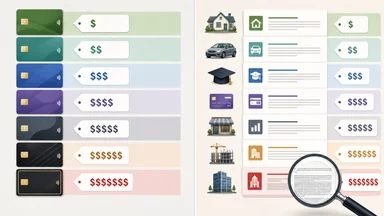
Imagine you walk into seven different stores looking for the same toaster. One store asks $18, another asks $31. That's roughly the range of annual percentage rates (APRs) a typical credit card applicant might see today — from 18 percent on the low end to 31 percent on the high end. For personal loans, the spread can be even wider: some estimates put the difference between the cheapest and most expensive offer for the same borrower at roughly 13 percentage points. The loan is the same. The borrower is the same. The price is not.
The Same Loan, Seven Different Prices
Credit card APRs, as of late 2024, typically fall between 18% and 31%, depending on the card and the applicant. But that range is just the advertised window. When a consumer applies, the actual rate they receive — called the purchase APR — can land anywhere inside that band, or sometimes outside it. A Federal Reserve study from a few years back found that nearly one in five approved applicants got a rate higher than the lowest rate they were quoted before applying.
Personal loans show an even wider gap. For a borrower with a mid-range credit score — say, 680 — one lender might offer 8% while another quotes 21% for the same principal and term. That difference of 13 points translates into thousands of dollars in extra interest over the life of a five-year loan. The Consumer Financial Protection Bureau (CFPB) has documented that shopping around can lower rates, but it requires submitting applications that trigger hard inquiries, which can temporarily ding a credit score.
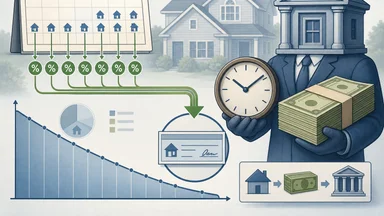
Consider a concrete example: a borrower seeking a $10,000 personal loan with a five-year term. At 8% APR, the total interest paid would be roughly $2,160. At 21% APR, the total interest jumps to about $6,140 — a difference of nearly $4,000. That is the kind of gap that can mean the difference between manageable debt and a financial strain that lasts years. For larger loans, the numbers grow even more stark.
Buy now, pay later (BNPL) products advertise 0% interest, but the effective APR for a typical user can exceed 30% when late fees are factored in. A study from the CFPB found that roughly 40% of BNPL users incurred at least one late fee, and for those who paid late frequently, the annualized cost approached triple digits. Payday lenders, meanwhile, charge rates that can reach 300% to 600% APR, though some states cap those rates.
The puzzle is why the same borrower — same income, same credit score, same debt-to-income ratio — gets such different prices. The answer lies in how lenders build their risk models and what data they use.
Why Shopping Around Fails Most Borrowers
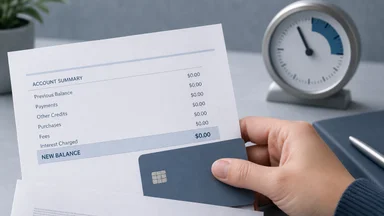
Conventional wisdom says compare offers before you borrow. But the mechanics of credit applications work against that advice. Every time a lender pulls a credit report for an application, it counts as a hard inquiry, which can lower a credit score by a few points. For someone on the edge of a scoring tier, a single hard inquiry could push them from good to fair, raising the rates they qualify for.
Lenders do not all use the same risk model. Each lender has its own proprietary scoring system, often built on top of the FICO or VantageScore base. One lender might weight payment history heavily; another might put more emphasis on credit utilization or the length of credit history. So the same credit profile can produce different risk scores at different institutions, leading to different rate offers.
Advertised rates are often "as low as" figures that only the most creditworthy borrowers receive. A study from the CFPB found that roughly one in five approved applicants received a rate that was higher than the lowest advertised rate for that product. The fine print on many loan offers allows the lender to adjust the rate after reviewing the full application, meaning the rate a borrower sees in a pre-qualification email may not match the rate on the final contract.
Even when borrowers do shop around, they often focus on the monthly payment rather than the APR. A longer loan term can lower the monthly payment while increasing total interest. Lenders know this and sometimes structure offers to highlight a low monthly number while burying a higher APR. The result: borrowers who think they are getting a deal may end up paying more over time.
There is also a behavioral dimension: many borrowers simply do not have the time or energy to compare multiple offers. A 2023 survey by the Pew Charitable Trusts found that roughly half of personal loan borrowers only considered one lender before accepting an offer. The reasons ranged from urgency (needing money quickly) to a belief that all lenders offer similar terms. The survey also found that borrowers who shopped around saved an average of roughly $500 in interest over the life of the loan, yet the majority still did not compare offers.
Furthermore, the tools meant to help comparison shop can be misleading. Online aggregator sites often show limited options — the ones that pay the highest referral fees — rather than a comprehensive market view. A borrower might think they have seen the full field when they have only seen a curated selection. This is especially problematic for borrowers with lower credit scores, who may be steered toward high-cost lenders that pay aggregators more.
The Hidden Cost of Convenience: BNPL and App-Based Lending
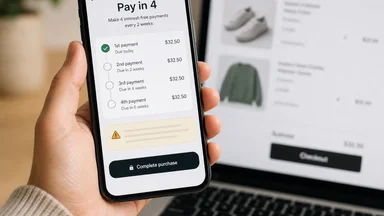
BNPL services like Klarna, Afterpay, and Affirm have exploded in popularity by offering installment plans with zero percent interest — as long as you pay on time. Miss a payment, though, and late fees pile up quickly. A typical late fee is around $7 to $10 per missed payment, and some services charge a percentage of the purchase amount. For a $50 purchase split into four payments, a single late fee of $8 works out to an effective APR of more than 30% on the outstanding balance.
The CFPB has warned that BNPL products can lead to "debt spirals" because users often take out multiple loans at once, losing track of due dates. One study found that roughly 40% of BNPL users incurred a late fee, and the average user with late fees paid the equivalent of a 30% APR on the amount financed. Because BNPL loans are typically not reported to credit bureaus, the hidden debt does not show up on credit reports, making it harder for other lenders to assess a borrower's true financial picture.
App-based lenders like Dave and Earnin offer cash advances with no interest but request "tips" or charge express fees that can translate into an effective APR of 200% or more for a short-term advance. These products are marketed as alternatives to payday loans, but the costs can be similar. A $50 advance with a $5 tip due in two weeks works out to an APR of roughly 260%.
Regulators have started to take notice. The CFPB has issued guidance that some BNPL products may be subject to the Truth in Lending Act, which would require clearer disclosure of costs. But as of mid-2026, enforcement has been limited, and many BNPL providers operate in a gray area that allows them to avoid interest rate caps.
There is a trade-off here: BNPL and app-based lenders provide access to credit for people who might not qualify for traditional loans. A borrower with a thin credit file or a low score may have no other option for short-term financing. The convenience of instant approval and no interest (if paid on time) is real. But the costs of falling behind are severe, and the lack of reporting to credit bureaus means that responsible use does not help build credit. Critics argue that these products are designed to profit from late fees and that the business model depends on a significant share of users paying them.
Another counter-argument comes from the industry: BNPL providers say that late fees are avoidable and that most users pay on time. They point to data showing that the majority of transactions incur no fees. However, that majority includes many small purchases where the risk of late payment is low. For larger purchases or users with multiple active loans, the probability of missing a payment rises. The CFPB's data suggests that the 40% of users who incur late fees account for a disproportionate share of the total cost.
How Lenders Use Data to Segment and Charge More
Lenders today have access to far more than just a credit score and income. Many now pull bank account transaction data to see how a borrower spends money — whether they pay rent on time, how often they overdraft, and what categories they spend on. This data, often called "cash flow underwriting," can reveal patterns that traditional credit scores miss. A borrower with a high credit score but frequent overdrafts might be seen as riskier than one with a slightly lower score and steady deposits.
Some lenders also use social media data, location history, and even the type of device used to apply for a loan. A 2020 study by researchers at the University of California found that lenders using alternative data could increase approval rates for minority borrowers by roughly 5 percent, but also charged higher rates to those same borrowers in some cases. The opacity of these models makes it hard for consumers to know why they got a particular rate.
AI-driven risk models can assign rates without human oversight, and the factors that drive those rates are often proprietary. A borrower with a FICO score of 720 might get a 12% APR from one lender and an 18% APR from another, simply because the second lender's model puts more weight on a factor like the number of recent credit inquiries or the age of the oldest account. The result: the same credit profile, different prices.
This kind of price discrimination is legal as long as it is not based on race, gender, or other protected characteristics. But proving discrimination in algorithmic pricing is difficult, because the models are complex and the data inputs are not transparent. The CFPB has issued guidance on "algorithmic fairness" but has not yet brought major enforcement actions against lenders for using alternative data in ways that produce disparate impact.
To understand how this plays out in practice, consider a borrower who uses a budgeting app that categorizes spending. That data might be shared with a lender, which then sees that the borrower spends heavily on dining out or entertainment. Even if the borrower has a high credit score and stable income, the lender might interpret the spending pattern as a sign of financial irresponsibility and offer a higher rate. The borrower never knows that their restaurant habits cost them an extra 3 percentage points on their loan.
There is a debate among economists about whether this kind of segmentation is efficient or exploitative. On one side, risk-based pricing is supposed to ensure that riskier borrowers pay more, which keeps credit available for everyone. Without it, lenders might have to charge a single high rate to all borrowers, driving away low-risk customers. On the other side, critics argue that the data inputs are often proxies for race or income, leading to de facto discrimination. For example, borrowers who live in low-income neighborhoods may have fewer bank transactions or different spending patterns, which could be used to charge them higher rates even if their credit scores are similar to those of wealthier borrowers.
The Regulatory Gap That Lets This Persist
The Truth in Lending Act (TILA) requires lenders to disclose the APR and other loan terms before a borrower signs. But TILA does not require lenders to justify why a particular rate was offered, nor does it ban price discrimination based on proprietary risk models. The Equal Credit Opportunity Act (ECOA) prohibits discrimination on the basis of race, color, religion, national origin, sex, marital status, age, or receipt of public assistance — but it does not ban charging different rates to different borrowers based on risk, as long as the risk model is not discriminatory on its face.
State-level interest rate caps exist for payday loans in roughly 18 states, but online lenders often find ways around them by partnering with banks chartered in states with no caps. The so-called "rent-a-bank" model allows a nonbank lender to originate loans at rates that would be illegal under state law, as long as a bank is nominally involved. The CFPB has proposed rules to close this loophole, but as of 2026, the rules have not been finalized.
The Federal Reserve periodically publishes a list of distressed or underserved nonmetropolitan middle-income geographies, which can trigger additional review for banks operating in those areas. But the list, last updated in June 2026, focuses on geographic access to credit, not on price disparities. A borrower in an underserved area might have fewer lender options, leading to less competition and higher rates.
Another regulatory gap concerns the use of alternative data. The Fair Credit Reporting Act (FCRA) governs how credit reporting agencies handle data, but it does not clearly apply to non-traditional data sources like bank transaction histories or social media activity. Lenders that use these data sources are not required to disclose them to borrowers, nor are they required to allow borrowers to correct errors. This creates a black box where a borrower's rate could be influenced by inaccurate or misleading information that they cannot see or challenge.
Industry groups argue that more regulation would stifle innovation and reduce access to credit. They point to the success of alternative data in expanding credit to the "credit invisible" — people with no traditional credit history. A 2023 report from the Financial Health Network found that lenders using cash flow underwriting approved roughly 20% more applicants than those using only credit scores, and that the default rates were similar. The implication is that alternative data can be both inclusive and accurate. But the same report noted that the rates charged to these new borrowers were often higher than those charged to similar-risk borrowers with traditional credit files, suggesting that the savings from better risk assessment were not being passed on.
What Borrowers Can Actually Do to Narrow the Gap
Start by checking prequalified offers that use a soft pull — a credit check that does not affect your score. Many credit card issuers and personal loan platforms offer prequalification tools that show you an estimated rate range before you formally apply. This lets you compare offers without the penalty of multiple hard inquiries.
Compare APRs, not monthly payments. A lower monthly payment might come from a longer term that costs more in total interest. Use an online calculator to see the total cost of the loan over its full term. Also look at fees: origination fees, late fees, and prepayment penalties can add up quickly.
Credit unions often cap rates on personal loans at 18% — roughly half the typical credit card APR. If you are a member of a credit union, check their loan rates before going to a bank or online lender. Some credit unions also offer debt consolidation loans at rates below 10% for qualified borrowers.
Consider negotiating with your existing bank or credit card issuer. If you have a good payment history, you may be able to get a lower rate on a personal loan or a balance transfer offer. Issuers sometimes match competitor offers to retain customers.
Finally, wait if you can. Improving your credit score by even 20 points can move you into a lower rate tier. Pay down credit card balances, dispute errors on your credit report, and avoid new credit inquiries for six months. Then reapply. The difference in APR can be significant.
Beyond these individual steps, there is a broader need for systemic change. Consumer advocates recommend that regulators require lenders to disclose the top three factors that influenced a borrower's rate, similar to the adverse action notices required for credit denials. This would give borrowers a clearer picture of what drives their price and allow them to address specific weaknesses. Some states have started to experiment with rate review boards that would approve or reject rate structures for consumer loans, though no such board has been fully implemented yet.
Another idea gaining traction is the creation of a public credit registry that would collect loan-level data on rates and terms, allowing researchers and regulators to monitor price dispersion and identify lenders that systematically charge higher rates to certain groups. The CFPB has the authority to collect such data under the Dodd-Frank Act, but has not yet done so for personal loans. A pilot program in a single state could provide proof of concept, but political will is lacking.
In the meantime, borrowers must navigate a system that is designed to extract as much as the market will bear. The seven different prices for the same loan are not a bug — they are a feature of a market where information is asymmetric and bargaining power is unequal. Understanding that is the first step to fighting back.
This article is for informational purposes only and does not constitute personalized financial advice. Consult a qualified professional for advice tailored to your situation.