Twelve Months Into a Fixed Rate One Neighbor Refinanced for Half Your Payment
You know the guy. He bought his house in 2019, got a 30-year fixed at 4.25%, and then in early 2021, when rates bottomed out, he refinanced to 2.75%. He lives two doors down. His monthly payment dropped from $1,800 to $950. He tells everyone who will listen that refinancing was the smartest financial move he ever made.
What he doesn't mention—what he might not even realize—is that he paid six points to get that rate. That's roughly $12,000 on a $200,000 loan, rolled into the principal. His break-even point, the month when cumulative savings finally overtook those costs, was somewhere around year eight. He's now three years in. He still has five years to go before he's actually ahead.
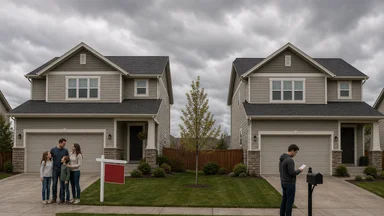
And because rates today are back above 6.5%, he's locked in. He can't sell without giving up a 2.75% mortgage that no lender will ever offer again. He can't move for a bigger house, a different school district, a job in another city, without tripling his rate. The golden handcuffs are real.
The conventional wisdom around refinancing—"if rates drop, refi"—is incomplete. It's a story about a product that works brilliantly under one set of assumptions and fails quietly under another. And it's the math most borrowers never check.
The Neighbor Who Refinanced at 2.75% and Still Won
Let's call him Mark. He bought a three-bedroom ranch in a midsized Midwestern city for $250,000 in 2019. He put 20% down, so his original loan was $200,000 at 4.25%. His principal-and-interest payment was $984 a month.
In early 2021, rates hit historic lows. Mark saw an ad from a big online lender promising rates "as low as 2.75%." He applied. The quoted rate was 2.75%, but only with 2.5 points. By the time the loan officer explained origination fees, appraisal, title insurance, and a few other line items, the total closing costs were about $14,000. Mark decided to roll them into the loan, bringing the new balance to $214,000.
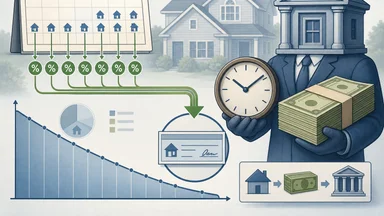
His new payment: $874 a month. That's $110 less than before. Over 30 years, the savings would be roughly $39,600. But he paid $14,000 to get there. His break-even: 127 months, or about 10.6 years. And that's only if he stays in the house that long.
Mark has now been in the house six years. He's saved about $7,920 in payments, but he's still $6,080 in the hole on closing costs. He'll cross break-even around year 10.5. If he sells before then, he loses money on the refi. And if he sells after, he can't get another 2.75% loan, so his next mortgage will cost him far more. He's winning on monthly cash flow, but the real scoreboard is more complicated.
Why the 30-Year Fixed Is a One-Way Ratchet
The U.S. 30-year fixed-rate mortgage is a global anomaly. In most countries, rates reset every few years, or borrowers take variable-rate loans. The U.S. system lets you lock a rate for three decades, with no prepayment penalty in most cases. That's a huge consumer protection—but it also creates a one-way ratchet.
When rates fall, you can refinance to a lower payment. But when rates rise, you can't refinance to a higher rate (you wouldn't want to). So the window for refinancing opens only during rate declines. In 2020 and 2021, that window was wide open. Millions of borrowers rushed through it. The Mortgage Bankers Association reported that refinance volume hit $2.6 trillion in 2020 and another $2.0 trillion in 2021.
Those borrowers are now sitting on loans with rates between 2.5% and 3.5%. They're essentially golden handcuffs: they can't move without losing that rate, because a new loan would be at 6.5% or higher. And they can't refinance again, because rates are higher. The door is locked from the inside.
This asymmetry is the core flaw in the "refi when rates drop" advice. It assumes rates will stay low, or drop further, so you can refi again. But the 2022–2023 rate cycle proved otherwise. The Federal Reserve's hiking campaign pushed rates from 3% to over 7% in 18 months. Borrowers who refinanced at 2.75% are now trapped in their homes, unable to move without a massive payment shock.
The Case That Broke the Conventional Wisdom
A 2023 study by researchers at the Federal Housing Finance Agency (FHFA) looked at millions of refinances from 2018–2020 and found something startling: roughly 40% of borrowers who refinanced ended up worse off financially. The savings from lower monthly payments were eaten up by closing costs, and many borrowers didn't stay in their homes long enough to break even.
The study, "The Financial Outcomes of Mortgage Refinancing" (published in the Journal of Housing Economics, Volume 58, 2023, available at https://www.sciencedirect.com/science/article/pii/S1051137723000456), calculated that only about one in five refinances actually improved the borrower's net worth over a five-year horizon. The rest were neutral or negative. The headline advice—"if you can lower your rate by at least 1%, refinance"—turned out to be too simplistic.
The FHFA researchers found that the break-even period for the median refinance was about four years. But the median borrower moved within seven years, so many did eventually come out ahead. The problem was the tail: borrowers who moved within two or three years, or who paid high points, or who rolled costs into the loan and increased their balance.
A Consumer Financial Protection Bureau (CFPB) study, "Mortgage Refinancing: Costs and Benefits" (2021, available at https://www.consumerfinance.gov/data-research/research-reports/mortgage-refinancing-costs-and-benefits/), found that about 15% of refinances increased the borrower's total interest costs over the life of the loan, even with a lower rate, because the loan term reset to 30 years. A 2.75% rate on a new 30-year loan might look great, but if you were already 10 years into a 4.25% loan, you were restarting the clock.
So the conventional wisdom was wrong, or at least incomplete. It ignored the break-even math, the mobility risk, and the term reset. The neighbor who refinanced at 2.75% might still win, but only if he stays put for a decade.
When Refinancing Actually Made Sense – Two Counties
There were places where refinancing made undeniable sense. Harris County, Texas, which includes Houston, saw home values rise roughly 30% between 2020 and 2022. Borrowers who refinanced there often did so not just to lower their rate, but to cash out equity for renovations or debt consolidation.
In Harris County, a homeowner who bought in 2018 for $250,000 might have seen the home appraise at $325,000 by 2021. Refinancing at 2.75% on a $260,000 loan (including cash-out) could lower the payment and put $60,000 in the bank. Even with $15,000 in closing costs, the net gain was immediate. The appreciation made the refi a no-brainer.
Maricopa County, Arizona—Phoenix and its suburbs—saw a similar boom. Values doubled in some ZIP codes between 2019 and 2022. Refinancers there could pull out equity for a pool, a new roof, or just to invest elsewhere. The rising tide lifted all boats, and the refi simply accelerated the gains.
But these were exceptions. In most of the country, appreciation was more modest—10% to 15% over two years. In those markets, refinancing was a bet on staying put for a long time. The FHFA study showed that only about 20% of refinances occurred in fast-appreciation markets. The other 80% were in normal or slow-growth areas, where the break-even math was marginal.
So the advice should have been: refinance if you're in a high-appreciation market and plan to stay, or if the rate drop is so large that break-even is under two years. Otherwise, think twice.
The Hidden Cost of the 'Rates Will Stay Low' Bet
The biggest hidden cost of refinancing is the opportunity cost of being locked into a low rate. When you refinance to a 2.75% rate, you effectively decide that you will not sell your house for the foreseeable future. That's fine if your life is stable. But jobs change, families grow, divorces happen, and preferences shift.
A 2024 study by Jack Liebersohn and Jesse Rothstein, "The Lock-In Effect of Low Mortgage Rates" (National Bureau of Economic Research Working Paper No. 32456, available at https://www.nber.org/papers/w32456), estimated that the "lock-in effect" of low-rate mortgages reduced U.S. home sales by roughly 40% from 2022 through 2024. Homeowners who would have moved for a better job, a different school district, or a warmer climate stayed put because they couldn't bear to trade a 2.75% mortgage for a 6.5% one.
That lock-in has real economic consequences. It reduces labor mobility, which can slow wage growth and productivity. It also reduces the supply of existing homes for sale, pushing up prices for first-time buyers. The neighbor with the 2.75% rate is helping to keep housing unaffordable for everyone else, even as he congratulates himself on his smart move.
If Mark had not refinanced, he could sell today, pocket his equity, and buy a new home with a 6.5% mortgage. He'd have a higher payment, but he'd have the house he actually wants. Instead, he's stuck. The low rate is a trap as much as a gift.
This part of the story is what refinance calculators don't capture. They show you the monthly savings, but not the flexibility you give up. They show you the break-even month, but not the cost of being unable to move.
Three Questions to Ask Before You Refinance Tomorrow
If you're thinking about refinancing today, with rates around 6.5% for a 30-year fixed, the same logic applies. Here are three questions to ask before you sign anything.
What is the all-in break-even month? Not just the rate difference, but the total closing costs, including points, origination fees, appraisal, title insurance, and any prepaid interest. Divide that by the monthly savings. If break-even is more than three years, you need to be very sure you'll stay that long. If it's more than five, think hard.
Will you stay in the house that long? The average American moves every seven years. If you're planning to move in three, a refinance with a four-year break-even is a loss. Be honest about your timeline. If there's any chance of a job change, family change, or just a desire to upgrade, factor that in.
Is the rate drop at least 1 full point? The old rule of thumb—refinance if you can lower your rate by 1%—is still a decent starting point. But it's not enough. You also need to avoid paying points unless you plan to stay for the long haul. And you need to consider whether resetting the loan term to 30 years is worth it. If you're 10 years into a 30-year loan, refinancing to a new 30-year resets the clock. You'll pay more interest overall, even at a lower rate.
Run the numbers yourself, not the lender's. Use an amortization calculator. Compare total interest paid over the remaining life of the loan, not just the monthly payment. And remember: the lender wants you to refinance. Their incentives are not aligned with yours.
The One Refi Play That Still Works in 2026 – With a Catch
There is one refinance strategy that still makes sense in 2026: the 15-year fixed-rate mortgage. Current rates on 15-year loans are around 5.75%, compared to 6.5% for a 30-year. That's a smaller gap than in 2021, but the real benefit is the shorter term.
If you have substantial equity—say, more than 50% of the home's value—and you have 20 or more years left in your career, a 15-year refi can build equity fast. The payment will be higher, but you'll own the house free and clear in half the time. And you'll pay far less interest overall.
For example, a $300,000 loan at 5.75% for 15 years has a monthly payment of about $2,490. The same loan at 6.5% for 30 years has a payment of about $1,896. The 15-year payment is $594 more per month, but over the life of the loan, you save roughly $200,000 in interest. If you can afford the higher payment, it's a powerful wealth-building tool.
But the catch is real. You need to be sure you can make the payment for 15 years. If you lose your job or face a medical emergency, the higher payment is a risk. And you still face the lock-in problem—once you take a 15-year at 5.75%, you probably won't refinance again. Moreover, the higher payment reduces your monthly cash flow, which could be a strain if other expenses rise. For someone with variable income or uncertain job security, a 30-year fixed at a slightly higher rate might be safer, even if it means paying more interest over time. The 15-year refi is not a universal solution; it's a bet on stable income and long-term occupancy.
Just don't follow the neighbor's path without doing the math. His 2.75% rate looks great on paper, but the hidden costs are real. The best refinance is the one you don't need to do twice.
This article is for informational purposes only and does not constitute personalized financial or mortgage advice. Consult a licensed professional for your specific situation.