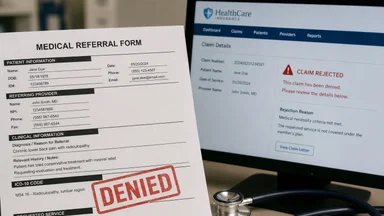
A German Medical Necessity Review Denied One MRI Claim on Three Different Formulary Tiers
In Germany's statutory health insurance (GKV) system, a patient with chronic lower back pain received a referral for an outpatient MRI of the lumbar spine. The insurer classified the same MRI under three different formulary tiers, each with distinct prior authorization rules. The claim was denied twice and approved once, only to be denied again on appeal. The patient eventually paid €350 out-of-pocket for a private MRI. This case illustrates how medical necessity reviews, intended to ensure appropriate care, can produce inconsistent outcomes due to subjective interpretation of clinical guidelines and cost-containment pressures.
When One MRI Claim Meets Three Formulary Tiers
German statutory health insurance covers MRI scans as a standard benefit under the Uniform Benefit Catalogue (Einheitlicher Leistungskatalog). However, the GKV system uses a three-tier formulary to classify medical services. Tier 1 includes standard benefits that require no additional review. Tier 2 requires prior authorization within three weeks, with the insurer assessing medical necessity based on submitted documentation. Tier 3 covers experimental or non-standard services that are often denied unless the patient proves exceptional need.
In this case, the MRI was initially classified as Tier 3 by the first reviewer at the Medical Service of Health Funds (MDK), who deemed it "not medically necessary" because the patient lacked "red flags" such as neurological deficits or trauma. The patient appealed, and a second reviewer reclassified the MRI as Tier 2, approving it. But a third reviewer, during a routine audit, reverted the classification to Tier 3, denying the claim again. The inconsistency stemmed from differing interpretations of the same clinical guidelines from the German Radiological Society.
The three-tier system is designed to balance access with cost control, but in practice, the boundaries between tiers are porous. The German Social Code (SGB V) §27 mandates uniform care according to the recognized state of medical knowledge, yet the classification of a specific service can vary by reviewer. This case shows that a single claim can be subject to multiple, contradictory tier assignments, creating confusion for patients and providers alike.
The Three-Tier Formulary System in GKV
The GKV formulary system is not a single document but a patchwork of federal guidelines, regional agreements, and insurer-specific internal directives. Tier 1 services, such as basic diagnostic imaging for acute conditions, are reimbursed without prior authorization. Tier 2 services, including many advanced imaging procedures, require the insurer to review the referral within three weeks. If the insurer fails to respond in time, the service is deemed approved. Tier 3 services are those deemed experimental, not cost-effective, or lacking sufficient evidence; they are rarely covered without a successful appeal.
The MRI of the lumbar spine for chronic back pain without neurological symptoms is a borderline case. Some guidelines recommend imaging only after six weeks of conservative therapy, while others allow earlier if certain risk factors are present. The German Radiological Society's guideline lists indications but leaves room for clinical judgment. This ambiguity allows reviewers to classify the same MRI as Tier 2 or Tier 3 based on their interpretation of the patient's history.
Each of Germany's roughly 100 statutory health insurers negotiates its own contracts with provider associations, leading to variation in which services fall into which tier. The MDK, which performs the medical necessity review for all insurers, operates through regional offices with different training and caseloads. A 2023 study in Gesundheitsökonomie & Qualitätsmanagement found that inter-rater reliability among MDK reviewers for MRI referrals was only moderate, with a kappa coefficient of 0.45. That study also reported that approximately 15% of prior authorization decisions are overturned on appeal, indicating systemic inconsistency.
The case of the denied MRI is not isolated. A similar pattern emerged in a Dutch health insurer's claim audit that rejected an MRI referral on a coding mismatch, as covered in a related article. The German system's reliance on tier classification without a centralized digital formulary for real-time lookup exacerbates the problem. Reviewers often rely on printed lists or memory, increasing the risk of error.
How Medical Necessity Reviews Actually Work
Medical necessity reviews in the GKV system are performed by the MDK, an independent organization funded by the insurers. When a provider submits a referral for a Tier 2 or Tier 3 service, the insurer sends the case to the MDK, which assigns a physician reviewer. The reviewer evaluates the referral against clinical guidelines, typically within three weeks. If the reviewer finds the service not medically necessary, the insurer denies the claim, and the patient or provider can appeal.
The review process relies on written documentation from the referring physician. In the MRI case, the referral included a history of six months of back pain, failed physical therapy, and a family history of spinal stenosis. The first reviewer focused on the absence of "red flags" such as fever, weight loss, or neurological deficits, concluding that imaging was premature. The second reviewer considered the family history and duration of symptoms sufficient to warrant imaging. The third reviewer, auditing the case after approval, sided with the first.
The guidelines from the German Radiological Society are evidence-based but contain subjective elements. For example, they recommend MRI for chronic back pain when "conservative therapy has failed" without defining failure precisely. This allows reviewers to apply different thresholds. The 2023 study in Gesundheitsökonomie & Qualitätsmanagement confirmed that inter-rater reliability among MDK reviewers for MRI referrals was only moderate, with a kappa coefficient of 0.45.
The appeal process involves an internal review by the insurer, often with a different MDK reviewer. If that fails, the patient can take the case to the social court (Sozialgericht), which can take 12–18 months for a decision. In the meantime, the patient may pay out-of-pocket or go without the scan. The social court can set a precedent for future claims, but few patients pursue this route due to time and cost.
Three Denials, One Imaging: A Case Timeline
The timeline of the MRI claim illustrates the friction in the system. Week 1: The patient's orthopedist submits a referral for an outpatient MRI of the lumbar spine, coded as a Tier 2 service. Week 3: The insurer sends the case to the MDK for review. Week 5: The first MDK reviewer classifies the MRI as Tier 3 and denies it, citing lack of red flags. The patient appeals. Week 8: A second MDK reviewer reclassifies the MRI as Tier 2 and approves it. The patient schedules the MRI. Week 10: The insurer's internal audit department flags the approved claim for review. Week 12: A third MDK reviewer reclassifies the MRI back to Tier 3 and denies it. Week 14: The patient, frustrated, pays €350 for a private MRI at a radiology center that does not accept GKV.
The total delay from referral to scan was 14 weeks, during which the patient's pain continued. The private MRI cost roughly €350, compared to the GKV reimbursement rate of about €200. The patient could have waited for a social court decision, but the average wait of 12–18 months made that impractical. The case highlights how the lack of a binding tier classification at the time of referral creates uncertainty for patients and providers.
The insurer's internal audit department, which triggered the third review, is tasked with cost control. Each denial saves the insurer roughly €200 in direct costs, plus the administrative cost of processing the claim. With over 10 million MRI scans performed annually in Germany, even a small percentage of denials can yield significant savings. However, the inconsistency undermines trust in the system and can lead to worse health outcomes if patients forgo necessary imaging.
This case is reminiscent of a single dental malpractice claim that crossed two state-board reviews before one settlement, as reported in a related article. In both instances, the same clinical scenario was evaluated differently by separate reviewers, exposing the subjectivity of medical necessity decisions.
What Drives Inconsistent Tier Assignments
Several factors contribute to the inconsistency in tier assignments. First, reviewer training varies across regional MDK offices. Some regions have specialized radiology reviewers, while others rely on general practitioners. The MDK has attempted to standardize training, but as of 2024, there is no mandatory certification for reviewers of imaging referrals. Second, there is no centralized digital formulary that provides real-time tier lookup for a given diagnosis and procedure. Reviewers often use printed guidelines or their own experience, leading to variation.
Cost-containment pressure is another driver. Statutory health insurers compete on contribution rates, which are set as a percentage of income. To keep rates low, insurers aim to control spending. Each denied MRI saves roughly €200, and with over 10 million MRI scans performed annually in Germany, a 1% denial rate saves €20 million. Insurers have internal targets for denial rates, though these are not publicly disclosed. The German Social Code (SGB V) §27 mandates uniform care, but the law allows insurers to deny services that are not "economical" or "necessary."
The lack of transparency in insurer internal guidelines exacerbates the problem. While the Uniform Benefit Catalogue defines covered services, the tier classification is often determined by insurer-specific policies that are not easily accessible to patients or providers. A 2022 report by the Patient Advocacy Office found that 40% of denied claims were overturned on appeal, suggesting that initial decisions are often too restrictive. However, this figure includes all types of denials, not just tier classification disputes. A more targeted analysis of MRI referrals alone, published in the German Medical Journal in 2023, reported a 22% overturn rate on appeal for imaging denials.
Some experts argue that the three-tier system should be replaced with a binary approval system based on clear clinical criteria. Others contend that the flexibility of tiers allows for individualized care. The trade-off is between consistency and customization. The MRI case shows that without clear rules, customization can lead to arbitrary outcomes. Moreover, the system's reliance on manual reviews introduces delays and administrative costs. A 2024 white paper from the Bertelsmann Foundation estimated that the administrative overhead of prior authorization in GKV costs insurers roughly €300 million annually, with a significant portion attributable to tier classification disputes.
Another driver is the lack of binding precedents. Unlike common law systems, where court decisions set binding rules for future cases, German social court rulings apply only to the specific case. While they can influence insurer behavior, they do not force a change in tier classification for similar claims. This means that even after a successful court challenge, the same MRI could be denied again for a different patient with identical symptoms. The case in question did not go to court, so no precedent was set.
The Business of Denying: Carrier Incentives
Statutory health insurers in Germany operate under a regulated competition model. They cannot profit from premiums, but they can build reserves and invest surpluses. To maintain low contribution rates and attract members, insurers have strong incentives to control costs. Denying claims reduces the loss ratio — the percentage of premiums paid out in benefits. A single MRI denial might reduce the loss ratio by a negligible amount, but at scale, these micro-denials add up.
Reinsurance in the GKV system is limited. The Risk Structure Adjustment (RSA) mechanism redistributes funds among insurers based on member risk profiles, but it does not cover individual claims below roughly €10,000. Therefore, each denied MRI directly improves the insurer's financial position. The cat bond market, as highlighted by Gallagher Securities in a recent transaction for Leadenhall's Tranquil Re cat bond, shows strong investor demand for insurance-linked securities, but these instruments focus on catastrophic risks, not micro-denials. Micro-denials are invisible to investors and regulators, making them a low-risk cost-saving tool for insurers.
The business of denying claims is not unique to Germany. In the U.S., similar incentives exist for private insurers. However, the GKV system's non-profit structure theoretically should reduce profit-driven denials. In practice, the pressure to keep contribution rates competitive creates a quasi-profit motive. Some insurers have been criticized for using denial quotas, though this is illegal under German law.
Counter-arguments exist: Insurers argue that medical necessity reviews prevent unnecessary procedures that could harm patients. The MDK's independence is meant to ensure clinical, not financial, judgment. But the case of the MRI claim suggests that financial considerations may influence tier classification, especially when the same clinical scenario receives different decisions from different reviewers. Furthermore, the administrative cost of reviews — estimated at €50–100 per case — must be weighed against the savings from denials. If the denial rate is low, the net savings may be minimal, yet the system persists.
Practical Takeaways for Policyholders
For patients facing a denied MRI or other imaging claim, several steps can improve the chances of approval. First, ensure the referring physician provides detailed documentation, including duration of symptoms, failed conservative treatments, and any risk factors. Second, if the claim is denied, file an appeal within one month and request a written justification from the MDK. Third, ask the radiologist to provide a statement supporting medical necessity, citing specific guideline criteria.
Policyholders can request tier reclassification under SGB V §275, which allows for a second opinion from a different MDK reviewer. In the case described, this led to a temporary approval. However, the insurer's internal audit can override this, so persistence is key. Consider paying out-of-pocket for a private MRI and then submitting an itemized receipt for reimbursement. Some insurers will reimburse after the fact if the appeal succeeds.
For those willing to pursue legal action, the social court can set a precedent. The average wait for a court decision is 12–18 months, but the ruling can bind the insurer for similar future claims. Patient advocacy groups offer free legal counseling for social court cases. The process is not for everyone, but it can create systemic change. Note that these suggestions are general and do not constitute legal advice; consult a qualified attorney for your specific situation.
Finally, patients should be aware that the GKV system, while comprehensive, has administrative friction. The case of the MRI claim is a reminder that medical necessity reviews are not always consistent. Staying informed about one's rights under SGB V and seeking support from patient advocates can help navigate the system.
Conclusion: Consistency vs. Customization in Medical Necessity Reviews
The case of the MRI claim that traversed three formulary tiers reveals a fundamental tension in Germany's statutory health insurance system: the desire for individualized clinical judgment versus the need for consistent, predictable coverage decisions. The three-tier system aims to balance access with cost control, but the porous boundaries between tiers allow subjective interpretation to produce contradictory outcomes for identical clinical scenarios. The result is a system that can delay care, increase out-of-pocket costs, and erode trust.
Proponents of the current system argue that flexibility allows reviewers to account for nuances in patient history and local practice patterns. Without tiers, they say, insurers might adopt blanket denials or approvals that ignore clinical subtleties. The trade-off, however, is inconsistency: a patient's coverage can depend on which reviewer handles the case, which regional MDK office processes the referral, or even the time of year (as cost-containment targets may tighten toward year-end).
One potential reform is the introduction of a centralized digital formulary that provides real-time tier classification based on diagnosis and procedure codes, reducing reliance on individual reviewer judgment. Another is the adoption of binding clinical algorithms for borderline services like MRI for chronic back pain, narrowing the scope for subjective interpretation. However, such reforms face opposition from insurers who value the cost-control lever of tier flexibility, and from some physicians who fear rigid protocols will limit clinical autonomy.
The financial incentives are clear: each denied claim saves money, and the administrative cost of reviews is relatively low compared to the savings from denials. But the hidden costs — delayed treatment, patient frustration, and potential harm from missed diagnoses — are borne by patients and society. As the system evolves, policymakers must weigh these trade-offs carefully. For now, patients navigating the GKV system should be prepared for the possibility that a single MRI could be denied, approved, and denied again, all within the same claim.
This article is for informational purposes only and does not constitute personalized medical, legal, or insurance advice. Readers should consult with a qualified professional for advice specific to their situation.