A Phoenix Adjuster’s Roof Inspection Missed a Second Hail Strike Embedded in the Same Loss
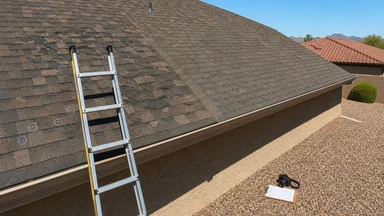
A Phoenix homeowner filed a hail-damage claim after a spring storm. The adjuster climbed the south-facing slope, noted granule loss and bruising on the asphalt shingles, and approved a partial roof replacement. Months later, during monsoon rains, water seeped through the north slope — a second hail strike that the initial inspection had entirely missed. The policyholder faced a supplemental claim, a second deductible, and a protracted dispute over coverage.
The Second-Strike Blind Spot
Single hail events can produce multiple impact zones. A storm cell may drop hailstones of varying sizes across a property, or wind patterns can concentrate damage on certain slopes. In the Phoenix case, the south slope showed clear bruising — soft spots where the shingle's fiberglass mat was compromised. The adjuster documented these, estimated the replacement cost, and the insurer issued a payment within two weeks.
But the north slope had been struck by a separate barrage of smaller hailstones that did not leave visible granule loss. Instead, they created micro-cracks in the shingle surface that only became apparent when water intrusion occurred months later. The contractor who performed the initial repair did not inspect the north slope because the adjuster's scope of work only covered the south-facing exposure.
The variance between the initial estimate and the supplemental request was substantial. The first estimate came in at approximately $8,500 (based on industry averages for a partial roof replacement in Phoenix). The supplemental, which included the north slope and associated interior drywall repair, added another $7,200. The policyholder was left with a second deductible — typically 1% of the dwelling limit — and a claim that now exceeded the storm's total damage by a significant margin.
The claim handler never re-inspected the property after the contractor flagged the leak. The adjuster's file notes indicated that the north slope was "not part of original scope" and that the supplemental was not reviewed until the contractor submitted a formal request, which triggered a desk review but no site visit. By then, the policyholder had already paid out-of-pocket for temporary repairs.
How Adjusters Are Trained to Scope Hail Losses
Industry-standard inspection protocols for hail damage focus on visible indicators: granule loss, bruising (soft spots), and cracking. The adjuster typically walks the perimeter, climbs a ladder to inspect gutters and downspouts, and may use a drone for steep slopes. But the standard protocol does not require a full survey of every roof plane unless damage is apparent from the ground or the policyholder reports a leak. Scheduling constraints amplify this gap. In hail-prone regions like the Southwest, a single adjuster may handle 8–12 inspections per day during storm season. The pressure to move quickly means that a slope without obvious damage is often skipped. The adjuster may assume that if the south slope is damaged, the north slope likely is not — an assumption that the Phoenix case disproves. Reliance on single-pass drone surveys introduces another blind spot. Drone imagery captures high-resolution photos of the roof surface, but it cannot detect subsurface bruising or micro-cracks. Thermal or moisture scanning, which can identify hidden damage, is rarely mandated for standard hail claims. Some carriers offer it as an optional service, but the cost — typically $200–$400 per inspection — is passed to the policyholder or deducted from the claim.
The result is a system that systematically under-scopes hail losses. A risk score model that denied a California exchange policy on a single smoker clause shows how algorithmic approaches can miss nuance; similarly, inspection protocols that rely on visible cues alone can miss embedded damage.
The $1 Trillion Premium Pool and Its Leakage Problem
The U.S. property/casualty industry wrote more than $1 trillion in direct premiums in 2024 for the first time, according to AM Best. Premiums grew another 5% in 2025, and underwriting profit reached its best level in a decade. But beneath the headline numbers, claims leakage — the difference between what an insurer should pay and what it actually pays — erodes margins.
Claims leakage takes many forms: overpayment on inflated estimates, underpayment that leads to supplemental claims and policyholder friction, and outright fraud. AM Best does not publish a single industry-wide leakage figure, but some estimates put the total between 5% and 10% of incurred losses. For a $1 trillion premium pool, that translates to tens of billions of dollars annually.
Staged-loss schemes — where organized rings fabricate damage or inflate legitimate claims — mimic the pattern of the Phoenix case. A ring might file a small initial claim, receive a modest payout, then submit a larger supplemental for damage that was "discovered" later. The second strike in Phoenix was real, but the same mechanism can be exploited by bad actors.
The industry's recent underwriting discipline has narrowed the margin for error. With combined ratios in the mid-90s for many lines, a few percentage points of leakage can flip a profitable book into a loss. Carriers that fail to tighten claims handling risk giving back the gains of a hard market.
Why the Phoenix Case Escaped Detection
Several factors converged to allow the second strike to go unnoticed. First, the second impact zone was on a different roof slope — the north-facing side — which the adjuster did not climb. The initial estimate explicitly excluded the north slope, and the adjuster's notes stated that "no damage observed from ground level on north elevation."
Second, the contractor who performed the initial repair did not file a supplemental request until after the monsoon leak, nearly four months after the storm. By then, the claim file had been closed, and the adjuster had moved on to new assignments. The carrier's claims system did not automatically flag a reopened claim for re-inspection within the same storm event.
Third, no SIU (Special Investigations Unit) referral was triggered. The claim value fell below the typical referral threshold — often $25,000 or more — and there was no red flag such as a prior claim at the same address or a pattern of late supplements. The SIU relies on automated scoring models that look for specific indicators; a single missed slope on a first-time claimant does not register.
The policyholder's experience is instructive. He called the carrier's customer service line three times before the supplemental was assigned to a new adjuster, who conducted a desk review and approved the north slope replacement — but only after the policyholder agreed to pay a second deductible. The carrier's position was that the two strikes constituted separate occurrences, a reading that the policyholder disputed but lacked the resources to challenge.
How Organized Rings Exploit Inspection Gaps
Organized fraud rings are adept at exploiting the same inspection gaps that caused the Phoenix loss to be under-scoped. A ring might purchase a property with an older roof, file a hail claim, and collect a small payout for a partial replacement. Then, months later, they submit a supplemental claim for additional damage, often supported by invoices from a shell contractor.
The pattern is difficult to detect because each claim appears legitimate on its own. The initial adjuster sees visible damage and approves a reasonable scope. The supplement comes from a different adjuster who has no reason to question the original scope. The ring collects two payments for what should have been a single claim.
Insurers lose millions per ring per year, according to industry fraud databases. The Coalition Against Insurance Fraud estimates that property fraud — including hail-related schemes — costs carriers $30 billion annually across all lines. The Phoenix case is not fraud, but it demonstrates how the same procedural gaps can be weaponized by bad actors.
Claims departments have begun to respond. Some carriers now require a mandatory re-inspection for any claim that exceeds a certain threshold — say, $15,000 — regardless of whether the adjuster found damage on all slopes. Others have implemented claims-scoring algorithms that flag addresses with multiple claims within a 12-month period, even if the claims are for different perils.
The appointment of Nora Deveau as chief claims officer at Arch Insurance North America, effective August 2026, signals a broader industry shift toward claims-tech emphasis. Deveau, who served as deputy chief claims officer from 2022 to 2026, brings a background in process improvement and data analytics. Her mandate likely includes tightening inspection protocols and reducing leakage.
Tools That Can Catch the Second Strike
Several technologies exist to address the second-strike blind spot. AI-based hail-damage detection from satellite imagery can identify impact patterns across an entire roof, including slopes that a ground-level adjuster might skip. Companies like Cape Analytics and Nearmap offer post-storm analytics that compare pre- and post-event imagery to pinpoint damage zones.
Claims-scoring algorithms can flag repeat addresses or properties with a history of supplements. These models are trained on millions of claims and can identify patterns that human adjusters might miss — for example, a contractor who files a high volume of supplements on claims from the same storm event. Some carriers have integrated these scores into their claims workflow, triggering a mandatory re-inspection or SIU review.
Mandatory re-inspection for claims above a threshold — say, $10,000 — would have caught the Phoenix case. If the initial estimate had triggered an automatic second inspection by a different adjuster, the north slope damage would likely have been identified before the policyholder experienced a leak. Some carriers have adopted this approach for high-value claims, but it remains rare for mid-range residential losses.
Thermal imaging, which detects moisture trapped beneath shingles, can reveal hidden hail damage that is not visible to the naked eye. A thermal scan costs roughly $200–$400 and adds 20 minutes to an inspection. For a claim that might pay $10,000–$20,000, the return on investment is clear. Yet few carriers mandate it for standard hail claims, citing cost and adjuster training requirements.
These tools are not silver bullets. Satellite imagery can be obstructed by clouds or tree cover. AI models require large training datasets and can produce false positives. Thermal imaging requires dry conditions and a trained operator. But as the Phoenix case illustrates, the cost of missing a second strike — in policyholder dissatisfaction, leakage, and fraud exposure — may outweigh the cost of the tools.
Industry Observations on Inspection Gaps
In hail-prone regions, the frequency of multi-impact events is higher than many carriers acknowledge. A 2023 study by the Insurance Institute for Business & Home Safety found that approximately 15% of hail claims involve damage on multiple roof slopes that are not contiguous. The Phoenix case fits this pattern. The study recommended that carriers adopt a "full-roof survey" protocol for any claim where the initial estimate exceeds $5,000, but few have done so.
Adjuster training programs often emphasize speed over thoroughness. The typical adjuster certification course devotes 2–4 hours to hail damage identification, mostly through slides and written tests. Field mentorship is limited. A carrier that invested in a simulator program — where adjusters practice on mock roofs with hidden damage — reported a 30% reduction in supplemental claims within two years. That program, however, was discontinued after a budget cut.
The Phoenix case also highlights the role of contractor behavior. Some contractors are incentivized to file supplements late, after the initial claim is closed, because they can charge a higher margin on emergency repairs. The contractor in this case waited until the monsoon leak to file the supplement, which may have been a business decision rather than a timing coincidence. Carriers that track contractor supplement patterns can identify outliers, but few do so systematically.
Another factor is the deductible structure. Most policies impose a separate deductible for each occurrence. When a single storm produces two impact zones, carriers often treat them as separate occurrences, as happened in Phoenix. This creates a financial disincentive for policyholders to pursue legitimate supplemental claims. Some states have considered legislation to require carriers to treat multi-impact events as a single occurrence, but no such law has passed.
The industry's response to the second-strike blind spot has been uneven. Large national carriers have invested in satellite analytics and AI scoring models, but regional carriers and mutual insurers often lack the resources. The result is a two-tier system where policyholders of smaller carriers are more likely to experience the same oversight as the Phoenix homeowner.
Ultimately, the Phoenix case is a reminder that claims handling is a human process with human limitations. No technology or checklist can eliminate every error. But the industry can reduce the frequency and severity of second-strike misses by acknowledging the blind spot and building systems that compensate for it.