A Single Rideshare Driver’s Telematics Score Triggered Two Different Rate Hikes From the Same Insurer
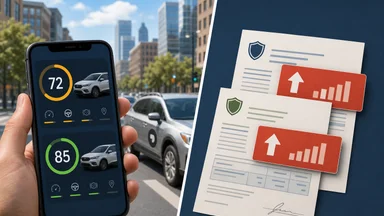
In early 2025, a rideshare driver in Austin, Texas, received a letter from his auto insurer informing him that his personal auto premium would increase by roughly 12 percent. Two weeks later, a second letter arrived: the commercial rideshare endorsement on the same vehicle was also going up, by about 15 percent. Both increases were tied to telematics data collected from a single device installed in his car. The driver held two policies with the same major carrier, and the insurer used separate scoring models for each—producing two different risk scores from the same driving behavior. He appealed both hikes. The insurer upheld them, citing independent underwriting rules. The case, which surfaced in a Texas Department of Insurance consumer complaint database and was shared with this reporter, illustrates a growing tension in usage-based insurance: when one driver is rated twice by the same company, using the same data, but through different algorithms, the result can look less like precision and more like double-dipping.
One Driver, Two Telematics Scores, Two Rate Hikes
The driver, who asked not to be named out of concern for his insurance standing, lives in Austin and drives for a rideshare platform roughly 25 hours per week. He purchased a personal auto policy from a major national carrier in 2023 and added a commercial rideshare endorsement, as required by the platform. To qualify for a discount, he agreed to install a telematics device that plugs into the vehicle's onboard diagnostic port.
The device recorded mileage, speed, hard braking, and time of day for every trip. The insurer used that data to assign a score for the personal policy, based on all driving time. Separately, the commercial endorsement used a different scoring model that considered only trips flagged as rideshare. According to the driver's complaint, his personal score fell into a "moderate risk" tier, triggering a rate increase. The commercial score, based on a smaller subset of trips, landed in a "higher risk" tier, triggering a second increase.
The driver told the insurer that the same driving habits could not be both moderate and high risk simultaneously. The insurer responded that the two policies were underwritten independently and that the telematics data was processed through separate algorithms with different weighting. Hard-braking events, for example, were weighted more heavily in the commercial model than in the personal model, because commercial use is considered inherently riskier.
Consumer advocates see this as a loophole. "If an insurer uses the same device to collect data for two policies, they should reconcile the scores so the driver isn't penalized twice for the same behavior," said a policy analyst at a consumer advocacy group who reviewed the complaint. "Otherwise, it's a form of double-counting risk." The insurer declined to comment on the specific case, citing privacy, but noted in a statement that its telematics programs are designed to reflect the distinct risk profiles of personal and commercial driving.
How Telematics Pricing Works in Dual-Policy Scenarios
Usage-based insurance (UBI) typically uses mileage and driving behavior to set premiums. For personal policies, the score reflects all driving—commutes, errands, leisure. For commercial endorsements on rideshare vehicles, the score often covers only periods when the driver is logged into the platform. The two rating models may use different algorithms, different weightings for behaviors like hard braking or speeding, and different baseline risk assumptions.
In theory, separate scoring makes sense: a driver who brakes hard during a personal trip may be a different risk than one who brakes hard while carrying a passenger. But when the same device feeds both models, the driver's combined score—if one were calculated—could be averaged or otherwise reconciled. The insurer in this case did not do that. Instead, it applied each score independently to its respective policy, effectively treating the driver as two separate risks.
This gap in rating algorithms is not unique to this carrier. A 2024 report by the Consumer Federation of America found that at least five major insurers offering both personal and rideshare policies did not cross-reference telematics data between lines. The report called for regulators to require disclosure of how multi-policy telematics scores are used. "Without transparency, drivers cannot know whether they are being charged fairly," the report stated.
The Texas driver's situation is a concrete example of the problem. His personal policy score was based on roughly 12,000 miles driven over six months, while the commercial score covered about 4,500 miles during rideshare hours. Because the commercial model used a smaller sample and weighted certain events more heavily, a few hard-braking incidents during rideshare trips pushed that score higher. The personal model, with more data, smoothed out those incidents. The result: two different risk classifications for the same person in the same car.
Regulatory Filing Reveals Algorithm Discrepancy
A Texas Department of Insurance filing from early 2025, obtained through a public records request, shows that the carrier in question used distinct telematics models for personal and commercial auto lines. The filing described the personal model as "a continuous monitoring algorithm that weights miles driven and event frequency over a rolling 12-month period." The commercial model was described as "a trip-based algorithm that evaluates event density during declared commercial periods."
The filing did not require the carrier to reconcile scores across policies. A department spokesperson said that Texas law does not mandate cross-policy data integration for telematics programs, as long as each program's rating methodology is filed and approved. "The department reviews each program for actuarial soundness and unfair discrimination within its own line," the spokesperson said. "We do not currently have a framework for evaluating combined effects across lines for the same insured."
Consumer advocates argue this creates a regulatory blind spot. "The same data is being used to charge more money, but no single regulator is looking at the total impact on the driver," said the policy analyst. The filing also revealed that the carrier had tested a combined-score model internally but decided not to implement it, citing "operational complexity" and "potential adverse selection" if drivers with good personal scores but poor commercial scores could shift risk between policies.
The Texas department flagged the discrepancy during its review but did not block the filing. A note in the file reads: "Carrier acknowledges that dual-policy telematics may result in higher combined premiums. Carrier represents that each rating model independently produces a fair risk classification. No further action required." The filing was approved in March 2025.
The Driver's Claim and Insurer's Response
The driver disputed both rate hikes in writing within 30 days of receiving the second notice. He argued that the same driving data could not justify two different risk scores and that the insurer was effectively charging him twice for the same risk. He requested a combined score or a refund of the increase on one policy.
The insurer's internal appeals process took roughly 90 days. In its final response, the insurer stated that "each policy is a separate contract with its own underwriting guidelines. The telematics score for each policy is derived from the data applicable to that policy's coverage period and risk classification. No error has been found." The carrier offered no refund or adjustment.
The driver then filed a complaint with the Texas Department of Insurance, which assigned a case number and began an investigation. As of mid-2026, the department had not issued a ruling. The complaint is listed in the department's public database with the status "under review." A department spokesperson said the investigation is ongoing and that the driver has the option to request an administrative hearing if the department finds no violation.
The driver told this reporter that he has since switched insurers, choosing a carrier that uses a single telematics score for both personal and commercial coverage. His combined premium dropped by roughly 20 percent compared to the sum of the two policies with the previous insurer. He still pays more than he did before the rate hikes, but he said the new arrangement feels more transparent.
Industry Patterns: Double-Dipping Through Data Silos
The Austin case is not isolated. Similar complaints have surfaced in California and Florida, according to consumer complaint databases and interviews with advocates. In each instance, a driver with a personal auto policy and a rideshare endorsement from the same carrier received separate telematics-based rate increases. The insurers cited separate risk pools and independent underwriting.
Consumer advocates have begun calling the practice "telematics stacking." The term refers to the layering of multiple telematics-based surcharges from the same data stream. Unlike coverage stacking, which is legal in some states for umbrella policies, telematics stacking has no explicit regulatory sanction—but also no prohibition. "It's a gray area that insurers are exploiting," said a staff attorney at a national consumer law organization.
The National Association of Insurance Commissioners (NAIC) formed a working group in early 2026 to study multi-policy telematics issues. The group's preliminary report, released in June 2026, identified "potential for unfair discrimination when telematics scores are not reconciled across policies issued to the same insured." The report recommended that states require disclosure of how telematics data is used across lines and that carriers offer a combined-score option. However, the NAIC has no enforcement authority, and adoption of its recommendations is voluntary.
No federal rule governs multi-policy telematics. The Federal Insurance Office has not issued guidance. As a result, the practice varies by state and by carrier. Some insurers have begun offering unified scoring for drivers who hold both personal and commercial policies with them, but it is not standard. The market is moving slowly, and drivers bear the burden of monitoring their own rates.
Trade-Offs: Why Insurers Resist Unified Scoring
From the carrier's perspective, maintaining separate telematics models for personal and commercial lines is not purely about maximizing revenue. Actuaries argue that the two risk pools have fundamentally different loss profiles. A driver's behavior during personal trips—say, a relaxed Sunday errand—may not predict risk during a late-night rideshare shift when fatigue or passenger distraction is more likely. Combining scores could dilute the predictive power of the commercial model, potentially leading to underpricing for high-risk commercial drivers who exhibit safe personal habits.
Unified scoring also introduces operational challenges. If a driver's personal and commercial scores are averaged, a driver with a poor commercial score but excellent personal score might see a moderate combined score. That driver would then be cross-subsidized by drivers with the opposite pattern, unless the insurer adjusts base rates accordingly. Insurers worry that such averaging could attract drivers who know their commercial score is weak but their personal score is strong—a form of adverse selection. The carrier in the Austin case cited this exact concern in its internal memo.
Another trade-off is data granularity. Separate models allow insurers to tailor incentives: a driver who improves his commercial score could see a discount on that endorsement without affecting the personal policy. Under a unified model, improvements in one domain might be masked by the other, reducing the feedback loop for behavior change. Some insurers argue that this actually benefits drivers by smoothing out short-term fluctuations, but it also removes the ability to target interventions to the riskiest driving context.
Consumer advocates counter that these trade-offs are manageable with proper actuarial design. "Insurers routinely build complex models that account for multiple risk factors," said the policy analyst. "Combining two telematics scores is not rocket science. The real reason they don't do it is that separate scoring allows them to charge more." Indeed, the Texas filing noted that the carrier's internal combined-score model produced lower total premiums for roughly 60 percent of dual-policy drivers in its test sample. That suggests that for a majority of drivers, unified scoring would be cheaper—and the insurer chose not to implement it.
State-Level Variation in Telematics Oversight
The regulatory landscape for multi-policy telematics is fragmented. As of mid-2026, only a handful of states have addressed the issue explicitly. California's insurance department issued a bulletin in 2025 reminding carriers that rates must not be "excessive, inadequate, or unfairly discriminatory" and that using the same data to produce duplicative surcharges could be scrutinized under that standard. However, no formal rulemaking has followed.
Florida's Office of Insurance Regulation has taken a different approach. In 2025, it began requiring carriers that offer both personal and rideshare policies to file a disclosure statement explaining how telematics data is used across lines. The disclosure must be provided to policyholders at the time of enrollment. Consumer advocates say this is a step forward but note that disclosure alone does not prevent double-dipping—it only makes it visible.
Texas, as noted, has no such requirement. The department's review focuses on whether each individual rating model is actuarially sound. The combined effect on a single policyholder is not evaluated. This permissive environment may be why the Austin case arose there, but similar gaps exist in many states. The NAIC working group's recommendations, if adopted, would create a baseline, but adoption is voluntary and likely years away.
Meanwhile, some states have taken no action at all. In states where insurance departments are underfunded or lack expertise in telematics, carriers operate with minimal oversight. This creates a patchwork where drivers in some states have protections that others do not. For the rideshare driver in Austin, the lack of a state-level framework meant that his only recourse was a complaint process that remains unresolved.
Practical Steps for Rideshare Drivers to Protect Rates
Rideshare drivers who use telematics can take several steps to avoid double-dipping. First, they can ask their insurer whether a single device will be used to generate separate scores for personal and commercial policies. If the answer is yes, they can request a combined score disclosure—a single number that reflects both driving contexts—though insurers are not required to provide one.
Second, drivers can request separate telematics devices for each policy. This would physically separate the data streams, making it harder for the insurer to argue that the same data applies to both. However, some insurers may charge an additional device fee or require professional installation.
Third, drivers can compare quotes from carriers that offer unified telematics programs for rideshare use. A few insurers now market "one-score" policies that treat personal and commercial driving under a single rating model. These policies may offer a discount for drivers who use the same device for both, because the larger data sample can produce a more stable score.
Fourth, if a driver believes they have been unfairly surcharged, they can file a complaint with their state insurance department. Many states have online portals for consumer complaints. The process may take several months, but it creates a public record that can inform regulatory action. Drivers should keep copies of all correspondence and telematics score reports.
Finally, drivers can consider pay-per-mile insurers for rideshare use. These policies charge a base rate plus a per-mile fee, often without telematics-based behavior scoring. While the per-mile cost may be higher for heavy drivers, the pricing is transparent and avoids the risk of stacking surcharges. As of mid-2026, at least three pay-per-mile insurers offer rideshare endorsements in Texas.
This article is for informational purposes only and does not constitute professional insurance advice. Readers should consult a licensed insurance agent or attorney for guidance specific to their situation.